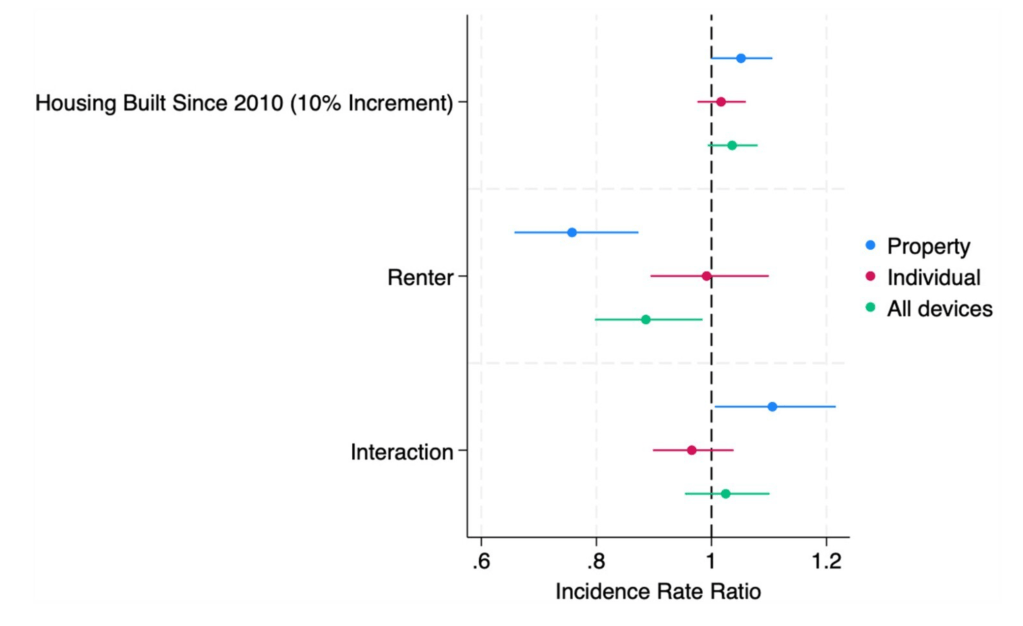
The recent SPLICE study “Privacy and Power in the Smart Home: Housing Market Conditions and Exposure to Smart Devices in Home Environments” shifts the focus from individual adoption to exposure — the presence of smart devices in a household, whether voluntarily chosen or imposed. In particular, the authors differentiate property-based (e.g., thermostats, appliances) and individual-based smart devices (e.g., televisions, health devices), under the assumption that exposure to property-based smart devices may be less responsive to individual preferences and proactive adoption. Analyzing a nationally representative survey of U.S. adults, the authors find that about 87 percent of respondents report at least one smart device at home, with homeowners generally reporting higher exposure than renters. However, renters’ exposure to property‑based devices (such as security systems, video doorbells, and thermostats) is far more sensitive to local housing market dynamics; a 10 percent increase in newly built housing corresponds to a 7.6 percent rise in renters’ exposure to these devices, while homeowners’ exposure changes little.
Beyond the effects of new housing construction on exposure by renter status, the research uncovers striking racial patterns: Black and Latino adults experience greater exposure to smart devices than white adults. Furthermore, relative to white adults, Black adults’ exposure to property-based smart devices increases as Black-white residential segregation in the housing market increases. In highly segregated counties, Black residents have up to 39 percent more property‑based device types than their white counterparts. Existing research suggests that racial segregation in housing markets decrease homeseeker choice in housing markets. The authors’ findings, thus, suggest that residential segregation may impose exposure to property-based smart devices on Black homeseekers. By highlighting how housing structures and segregation shape who is exposed to ubiquitous data‑collecting devices, the paper calls for policy attention to the privacy and power imbalances embedded in the built environment.
Read the full article:
Farr, S., Bruno, C., & Anthony, D. (2026). Privacy and power in the smart home: housing market conditions and exposure to smart devices in home environments. Information, Communication & Society, 1–28. DOI 10.1080/1369118X.2026.2703215








Leave a Reply