
With the growing availability, relatively low cost, and wider range of functionality of smart-home devices, these devices can be introduced into a home environment, unbeknownst to the resident of the home. To mitigate the threats to resident privacy and security that such a situation can pose, a robust mechanism is needed to understand which smart-home devices in a home’s vicinity are inside of the house and which are outside. To be robust, the system must account for changes, such as furniture being moved or devices changing location.
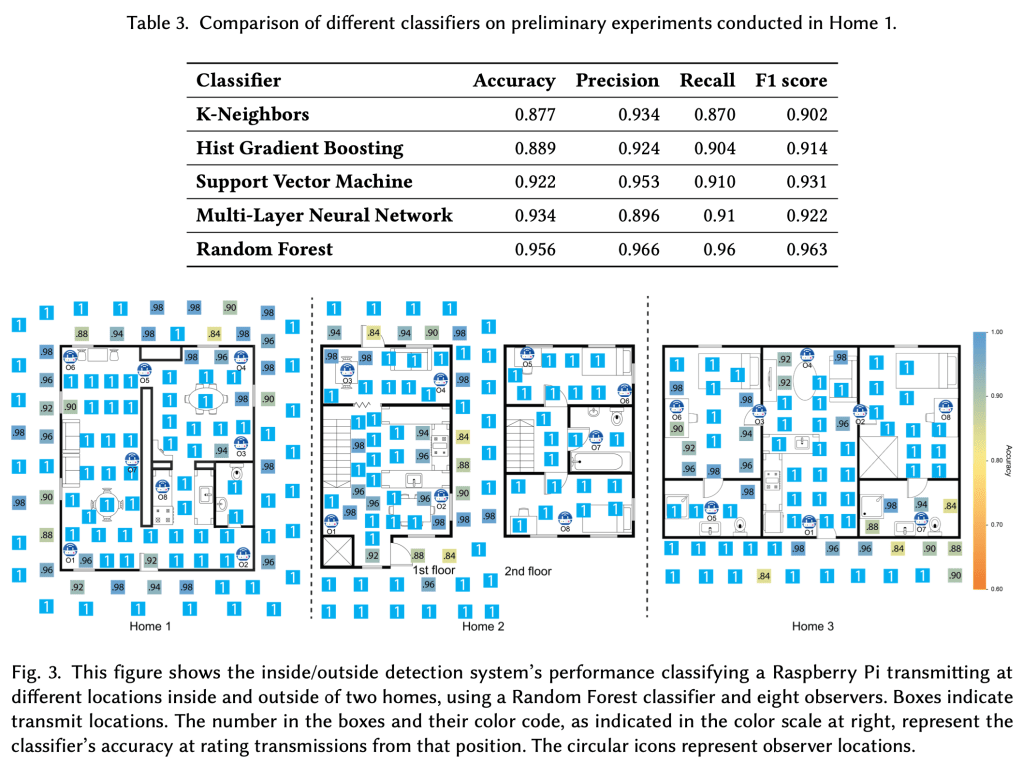
Moat is a robust system that leverages Wi-Fi sniffers to analyze the physical properties of a device’s wireless transmissions to infer whether that device is located inside or outside of a home. The concept of inside and outside contains both physical and social constructs. Moat can adaptively self-update to accommodate changes in the home indoor environment to ensure robust long-term performance. Notably, Moat does not require prior knowledge of the home’s layout or cooperation from target devices, and is easy to install and configure.
Read the full publication to learn more. Organizations interested in adapting this research are encouraged to contact the authors.
Wang, Chixiang, Weijia He, Timothy J. Pierson, and David Kotz. “Moat: Adaptive Inside/Outside Detection System for Smart Homes.” Proc. ACM Interact. Mob. Wearable Ubiquitous Technol. 8, no. 4 (November 21, 2024): 157:1-31. https://doi.org/10.1145/3699751.








 SPLICE
Leave a comment