
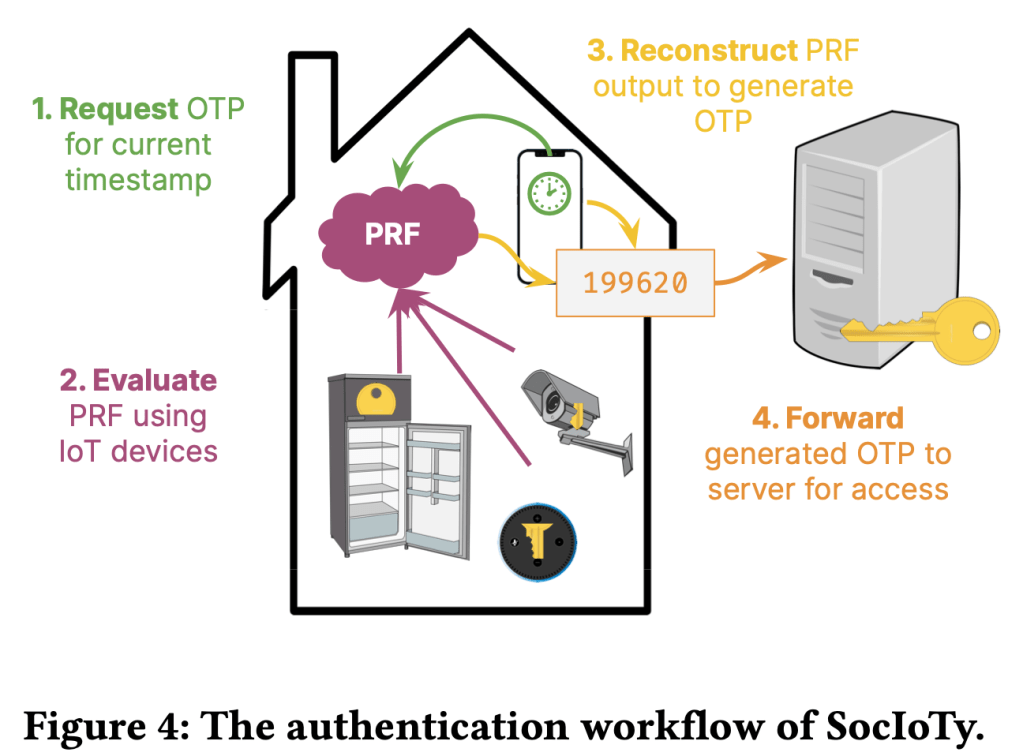
SocIoTy is a practical cryptography mechanism which leverages a user’s existing smart-home devices to add a context-sensitive layer of security. SocIoTy treats the smart home as a pseudorandom function that users can query to provide at-home cryptographic services. When the user is physically at home, they can generate pseudorandom function outputs, and use these outputs to address their real-world needs—like generation of one-time passwords for authentication and of keys for cloud-encrypted content.
Unlike existing privacy-enhancing systems, SocIoTy protects against common surveillance techniques even if the user’s devices are compromised (like during border searches). It ties cryptographic operations to the home using existing smart-home devices.
Check out the paper to learn more. You can find additional research from the SPLICE group here.


Jois, Tushar M., Gabrielle Beck, Sofia Belikovetsky, Joseph Carrigan, Alishah Chator, Logan Kostick, Maximilian Zinkus, Gabriel Kaptchuk, and Aviel D. Rubin. “SocIoTy: Practical Cryptography in Smart Home Contexts.” In Proceedings on Privacy Enhancing Technologies, 2024:447–64, 2024. https://doi.org/10.56553/popets-2024-0026.








 SPLICE
Leave a comment