
Phones, cameras, internet websites, and other devices constantly collect user data. The advent of so-called ‘Smart Things’ enables increasingly sensitive data to be collected inside the most private of spaces: the home. The first step in helping users regain control of their information that is collected inside their home is to alert them to the presence of potentially unwanted electronics.
In this paper, we present a system that could help homeowners (or home dwellers) find electronic devices in their living space. Specifically, we demonstrate the use of harmonic radars, sometimes called nonlinear junction detectors, which have also been used in applications ranging from explosives detection to insect tracking.
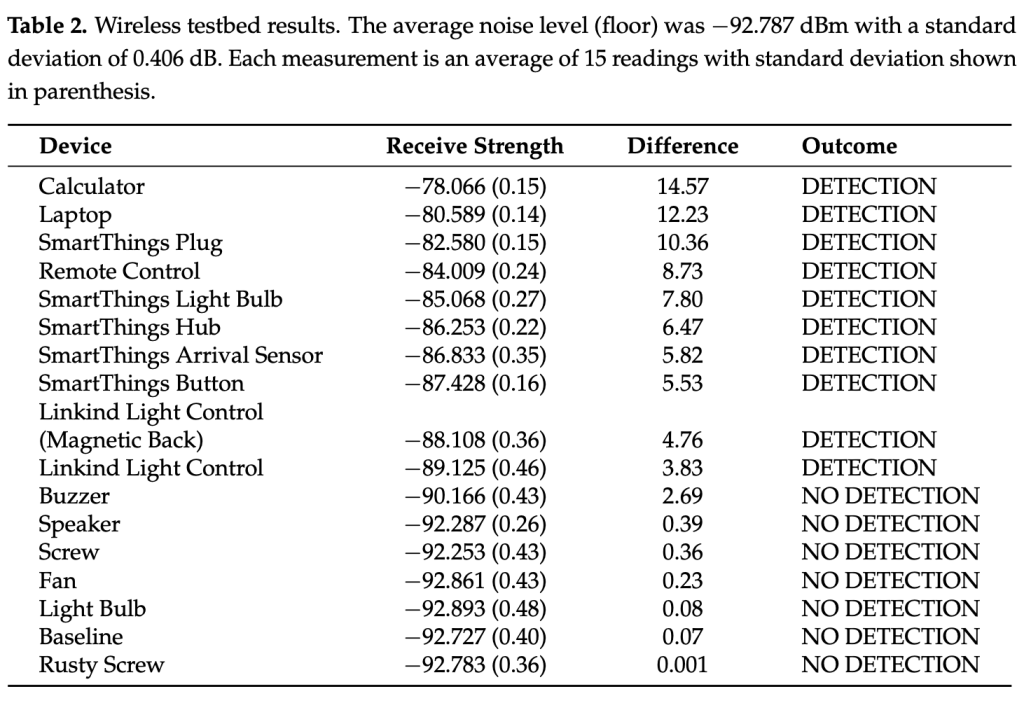
We adapt this radar technology to detect consumer electronics in a home setting and show that we can indeed accurately detect the presence of even ‘simple’ electronic devices like a smart lightbulb. We evaluate the performance of our radar in both wired and over-the-air transmission scenarios. Table 2 (below) presents the output of the experiments in the wireless testbed. We tested a set of 16 distinct devices (or objects) and showed that the electronic devices were detectable at distances ranging from 15 cm to 1 meter at different power levels.
To read more, check out the full paper here. To see other SPLICE publications, check out our Zotero page here.
Beatrice Perez, Gregory Mazzaro, Timothy J. Pierson, and David Kotz. Detecting the Presence of Electronic Devices in Smart Homes Using Harmonic Radar Technology. Remote Sens. 2022, 14, 327. https://doi.org/10.3390/rs14020327








 SPLICE
Leave a comment